August 2026 · ReflectionAgosto de 2026 · Reflexión
The LongingEl anhelo
A night at Cats: The Jellicle Ball opened a door to memories I had carried for decades — and to everything my younger self had been searching for: chosen family, belonging, and unconditional acceptance. Una noche en Cats: The Jellicle Ball abrió la puerta a recuerdos que había guardado por décadas — y a todo lo que mi yo más joven había estado buscando.
By Wilfredo PiñeiroPor Wilfredo Piñeiro
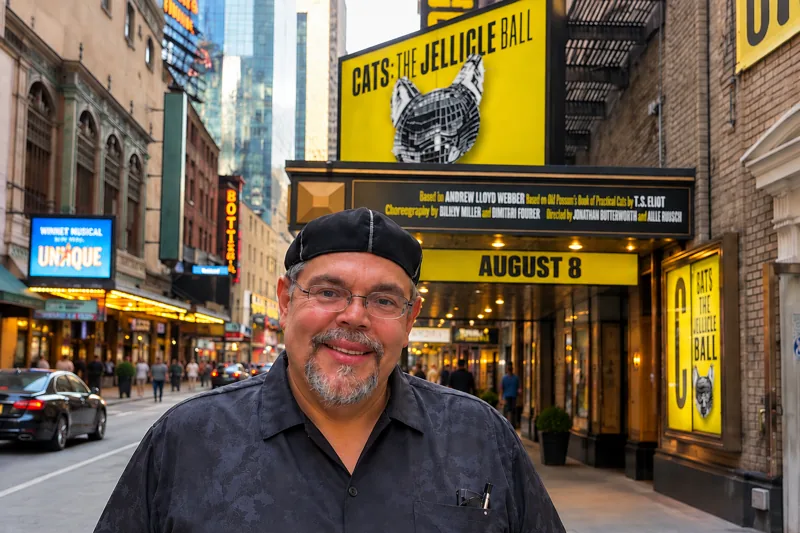
On Thursday, August 8, I attended the Broadway show Cats: The Jellicle Ball, expecting simply to enjoy a remarkable theatrical production. What I did not expect was that it would quietly open the door to memories I had carried for decades.
In the middle of the performance, images of queer people from the ballroom scene of the 1980s appeared on the screen. As I watched them, I unexpectedly saw my younger self sitting beside me. Not because I had been part of the ballroom community—I actually knew very little about that world until after high school—but because I recognized something much deeper in those faces. I recognized the longing.
As a young gay boy growing up in Puerto Rico during the early 1980s, I already knew I was different. I knew that who I was did not fit the expectations of my family, my culture, or the religious teachings that surrounded me. My memoir speaks about that internal battle—the constant search to understand myself while desperately wondering where I could be safe, where I could truly belong, and whether there was a place in the world where I would be accepted exactly as I was. At the time, I did not feel that place existed within my biological family or within my church.
Watching those photographs, I realized that although I had never walked the ballroom floor, I had been searching for exactly what many of those communities created for themselves: chosen family, artistic expression, authenticity, belonging, and unconditional acceptance. They built spaces where people who had been rejected by society could finally be seen, celebrated, and loved. That was exactly what my younger self had been searching for.
As I reflected on those images, my thoughts expanded beyond my own story and toward the LGBTQ+ community as a whole. I thought about how many of us have had to create chosen families because the families we were born into could not always offer the love, understanding, or acceptance we needed. I thought about how difficult it is to comprehend that, even in 2026, so many misconceptions, stereotypes, and myths about LGBTQ+ people continue to exist. Despite decades of education, advocacy, and visibility, there are still those who see our relationships as unnatural, our love as inferior, or our existence as something that needs to be explained or condemned.
Our community has endured extraordinary collective struggles. Stonewall became a symbol of resistance. The HIV/AIDS epidemic revealed both unimaginable loss and extraordinary courage. We continue to face healthcare disparities, discrimination, and changing political landscapes that challenge our rights and our dignity. These moments have united us and strengthened our collective voice.
Yet, as I sat in that theater, I realized that perhaps our greatest battle is not only the historical one. It is the battle each LGBTQ+ person fights every single day—the quiet, often invisible struggle to wake up and choose authenticity in a world that may still question your worth, your family, your love, or even your right to exist. That daily resilience may be one of the greatest strengths our community has developed—not because we wanted to, but because we had to in order to survive.
My heart especially goes out to those who have not yet found their chosen family. To those who continue searching for a place where they can finally exhale, where they can feel protected, valued, and loved without conditions. I think of LGBTQ+ youth who have been rejected by their families, who experience homelessness, and who sometimes exchange their safety, their bodies, or pieces of their innocence simply to have a place to sleep or something to eat. No young person should ever have to carry that burden.
As a person of faith, I reject the idea that these young people are suffering because God is punishing them for being LGBTQ+, just as I rejected the belief that AIDS was God's punishment against gay men. I believe their suffering reflects human rejection, prejudice, fear, and misunderstanding—not God's heart. Too often, religion has been used to justify exclusion rather than to extend compassion. I cannot reconcile that with a God whose greatest commandments are to love and to care for one another.
As the performance came to an end, I found myself thinking about the younger version of me—the frightened boy who wondered if life would ever get better. If I could have leaned over and whispered something to him in that theater, I would have simply said: “Despite all the pain, it got better. You found love.”
At that precise moment, I realized that this was the message I needed to hear—and perhaps one that many LGBTQ+ people still need to hear today.
El jueves 8 de agosto asistí al espectáculo de Broadway Cats: The Jellicle Ball, esperando simplemente disfrutar de una producción teatral extraordinaria. Lo que no esperaba era que abriría, en silencio, la puerta a recuerdos que había cargado durante décadas.
En medio de la función, aparecieron en la pantalla imágenes de personas queer de la escena ballroom de los años ochenta. Mientras las observaba, inesperadamente vi a mi yo más joven sentado junto a mí. No porque hubiera formado parte de la comunidad ballroom —en realidad conocía muy poco de ese mundo hasta después de la escuela secundaria—, sino porque reconocí algo mucho más profundo en aquellos rostros. Reconocí el anhelo.
Como un joven gay que crecía en Puerto Rico a principios de los años ochenta, ya sabía que era diferente. Sabía que quien era yo no encajaba en las expectativas de mi familia, de mi cultura ni de las enseñanzas religiosas que me rodeaban. Mis memorias hablan de esa batalla interna: la búsqueda constante por entenderme a mí mismo, mientras me preguntaba desesperadamente dónde podría estar a salvo, dónde podría pertenecer de verdad, y si existía un lugar en el mundo donde sería aceptado exactamente como era. En aquel entonces, no sentía que ese lugar existiera dentro de mi familia biológica ni dentro de mi iglesia.
Al ver aquellas fotografías, comprendí que, aunque nunca había caminado por la pista del ballroom, había estado buscando exactamente lo que muchas de esas comunidades crearon para sí mismas: familia elegida, expresión artística, autenticidad, pertenencia y aceptación incondicional. Construyeron espacios donde las personas que habían sido rechazadas por la sociedad podían, por fin, ser vistas, celebradas y amadas. Eso era exactamente lo que mi yo más joven había estado buscando.
Mientras reflexionaba sobre esas imágenes, mis pensamientos se ampliaron más allá de mi propia historia, hacia la comunidad LGBTQ+ en su conjunto. Pensé en cuántos de nosotros hemos tenido que crear familias elegidas porque las familias en las que nacimos no siempre pudieron ofrecernos el amor, la comprensión o la aceptación que necesitábamos. Pensé en lo difícil que es comprender que, incluso en 2026, sigan existiendo tantos malentendidos, estereotipos y mitos sobre las personas LGBTQ+. A pesar de décadas de educación, defensa y visibilidad, todavía hay quienes ven nuestras relaciones como antinaturales, nuestro amor como inferior, o nuestra existencia como algo que debe ser explicado o condenado.
Nuestra comunidad ha soportado luchas colectivas extraordinarias. Stonewall se convirtió en un símbolo de resistencia. La epidemia del VIH/SIDA reveló tanto una pérdida inimaginable como un valor extraordinario. Seguimos enfrentando desigualdades en la atención médica, discriminación y panoramas políticos cambiantes que desafían nuestros derechos y nuestra dignidad. Esos momentos nos han unido y han fortalecido nuestra voz colectiva.
Sin embargo, sentado en aquel teatro, me di cuenta de que quizás nuestra mayor batalla no es solo la histórica. Es la batalla que cada persona LGBTQ+ libra cada día: la lucha silenciosa, muchas veces invisible, de despertar y elegir la autenticidad en un mundo que todavía puede cuestionar tu valor, tu familia, tu amor o incluso tu derecho a existir. Esa resiliencia diaria puede ser una de las mayores fortalezas que nuestra comunidad ha desarrollado, no porque quisiéramos, sino porque tuvimos que hacerlo para sobrevivir.
Mi corazón está especialmente con quienes aún no han encontrado su familia elegida. Con quienes siguen buscando un lugar donde por fin puedan respirar, donde puedan sentirse protegidos, valorados y amados sin condiciones. Pienso en los jóvenes LGBTQ+ que han sido rechazados por sus familias, que viven sin hogar y que a veces intercambian su seguridad, su cuerpo o pedazos de su inocencia simplemente por tener un lugar donde dormir o algo que comer. Ningún joven debería jamás tener que cargar con ese peso.
Como persona de fe, rechazo la idea de que estos jóvenes estén sufriendo porque Dios los castiga por ser LGBTQ+, así como rechacé la creencia de que el SIDA era el castigo de Dios contra los hombres gay. Creo que su sufrimiento refleja el rechazo humano, el prejuicio, el miedo y la incomprensión, no el corazón de Dios. Con demasiada frecuencia, la religión se ha usado para justificar la exclusión en lugar de extender la compasión. No puedo reconciliar eso con un Dios cuyos mandamientos más grandes son amar y cuidar los unos de los otros.
Cuando la función llegaba a su fin, me encontré pensando en la versión más joven de mí: aquel niño asustado que se preguntaba si la vida alguna vez mejoraría. Si hubiera podido inclinarme y susurrarle algo en aquel teatro, simplemente le habría dicho: “A pesar de todo el dolor, mejoró. Encontraste el amor.”
En ese preciso momento, comprendí que ese era el mensaje que yo necesitaba escuchar, y quizás uno que muchas personas LGBTQ+ todavía necesitan escuchar hoy.
Stay ConnectedMantente en contacto
Be the first to know when new reflections and writings are added.Sé el primero en saber cuándo agrego nuevas reflexiones y escritos.
Thank you — you're on the list. (Demo only, no email is stored.) Gracias — ya estás en la lista. (Solo demostración, no se guarda ningún correo.)